Friday, 6 October 2017

Key Media Terms

Key media terms used in the production of our film:

180 Line Of Action/Rule:
During conversation with two characters, you must only film on one side of the line, at 180 degrees, this means both characters must be in full view of the camera. Camera angles can be altered  to close ups, medium shots etc. Filming at 360 degrees can change the set making the audience disengage with the film, creating a sense of disorientation.

Shot-reverse Shot:
Changing shots from a close up of one person to the close up of another, alternates between them, allowing the viewers to establish conversation and engagement, due to a differentiation in shot types.

Match On Action/Match Cut:
 The brain follows movement automatically as it detects things continuously. By using different movements, it creates diversions preventing viewers from paying attention into one scene fully. For example; using a long shot to show people sitting down and a person walking to the chair, the shot changes to close up as the person sat down, this makes the scene less noticeable as the audience pay attention to the movement and not the cut used. 

Underexposed lighting:
Enabling less lighting in the shot may create spooky and mysterious effect, needed in thriller movies like ours. 


Wide Angle Lens:

Using a wide angle camera shot allows the viewers to get a wider picture to save panning across a scene, the short focal length also shows differences in distances.


Normal Lens:

Using this camera shot allows you to see what our eyes normally see, this is most commonly used in films.

Framing-High Angle:

This type of shot is done using a tripod in a high position to be able to shoot facing down on a character to represent vulnerability, and a sense of being little and not powerful, alongside ideas of separation and isolation.


 Framing-Low Angle:

Camera angle pointing upwards, from a low angle to represent power/dominance.


Low Height Shot:
This is used to conceal a character's identity, by usually filming from low point to high point on a character, for example starting a shot via the shoes/feet to the head/face.


Long Shot:

This is used to show characters from head to foot to identify the background in relation to themselves.

Medium Long Shot:

This is used to show characters from ankles/knees up to perhaps compare a character to another to establish their differences, or introduce a character.


Medium Shot:

Closer than medium long shot, this shot is used to show a conversation between two or more characters, or establish the character from a different angle.

Medium Close Ups:

This is used to show detail in conversation such as reaction, emotion and feelings from a character, specifically their facial expressions, such as reaction shots.


Close Ups:

This is shown by only head, hands and feet, to depict detail, to perhaps make the viewers focus on something important to the plot. 


Extreme Close Ups:

This is shown by filming from the mouth, one eye or tiny detail, to perhaps present isolation by the trigger of a gun etc. to show suspense/fear, this is usually used in thriller.


Mobile Framing:

This is use to show movements, by framing portably.

Pan:

This shot shows movements across a scene, by a wide view to perhaps show how big/ the intensity of the object and used to follow motion, via tracking. This can also be used with a tripod to create smooth movements.


Tracking/Dolly Shot:

This is where a camera is usually mounted upon something containing wheels, this is also used to follow something or someone, or perhaps show how long something is. 

Hand Held Shot:

This is used as a point of view shot, documentary like, it appears to be as a person is filming in a trembling movement.


Graphic Editing:

Graphic editing has to appear as smooth as possible with similar lighting and colour as this involves the fading of a shape into a similar shape, shade and tone. The positioning on the screen must be kept the same throughout to prevent an obvious cut in the film.

Elliptical Editing:

Elliptical editing is when an action on the screen takes less time than it would in real life, the purpose of this is to cut out irrelevant time and then cut to an action side of the film to keep the attention of viewers.

Diegetic Sound:
This originates from the source in the scene, on or off screen. It can also be heard by characters on the set, for example footsteps through leaves.

Non-diegetic Sound:

This wouldn't be heard naturally in the scene as it is added through editing such as music or a voice over. This cannot be heard by characters.

Internal monologue:

This is type of narration, performed by a character. This is used to present a characters thought process.

Voice Over:

This represents unseen characters over related images to the dialogue performed

Independent genre research: Conventional iconography of thriller movies


Click for conventional iconography of thriller movies

Brief research of thriller title sequences


Marketing for short films


Thursday, 5 October 2017

Title Sequence Analysis

Gone Girl (Dir. David Fincher, 2014).
 
 
The title sequence of the thriller film 'Gone Girl' starts with a black screen and a incidental, non-diegetic drone. The high key, non-diegetic drone is used to create suspense and to instantly draw the audience's attention. After a second of the screen being pitch black, 'TWENTIETH CENTURY FOX and REGENCY ENTERPRISES present' appears on the screen in white. After a couple of seconds of it being on the screen, it fades back to black. Then, a voice over of a man starts saying 'when I think of my wife, I think of her head' just before the second message flashes up on the screen in white: 'a DAVID FINCHER film'. The use of the juxtaposition colours, black and white, is effective due to the fact that it demonstrates to the audience that there are good and bad characters in 'Gone Girl'. The contrast in the colours black and white are conventionally shown in thriller title sequences to show that someone or something is going to break the equilibrium in the film. This emphasises the tension and suspense of the thriller film.

 
The second shot in the title sequence of 'Gone Girl' is a medium close up shot of a woman with an expressionless face. This shot is used to show the audience that she is strange as she does not show any facial expressions to the man who is gently stroking her head: just stares. The incidental, non-diegetic drone and the voice over of the man is continued throughout this shot when he says 'I picture cracking her lovely skull, and spooning her brains, trying to get an answer'. This voiceover implies to the audience that the man and woman's marriage is unstable. The lighting in this shot is low key which intensifies the shadows around her and makes the woman in the shot appear quite moody and scary to the audience. The woman in the shot appears to be quiet pale skinned which could imply to the audience that the woman is physically or mentally unwell. The camera then slowly fades to black which suggests to the audience that time has passed.
 
 
In this shot of the title sequence in 'Gone Girl', the camera uses a long shot to show the audience the deserted environment. The shot uses low key lighting to create eerie atmosphere which is conventional for thriller films. The incidental, non-diegetic drone is sound bridged into this shot which upholds the suspension and supports conventionalisation of the thriller genre. A diegetic sound of water from the lake appears in the back ground to make the shot seem more realistic. Then the name of the film 'Gone Girl' appears on the screen in white writing, then slowly fades to silver, and finally completely fades away. This use of editing on the title of the film is effective as it reflects what the film is about: a girl who suspiciously disappears.
 
 
The pace of editing then increases and jump cuts to four different images of the environment over a period of eight seconds. This is effective as it gives the audience a sense to what the environment is like in this thriller film. In all the four shots, the lighting is low key which emphasises the tension as it makes the scene appear scarier. The sinister environment encourages the audience to keep watching the thriller film as it makes them want to see what's going to happen next. The incidental, non-diegetic drone is once again sound bridged into this shot which maintains the suspension and encourages the audience to continue watching.


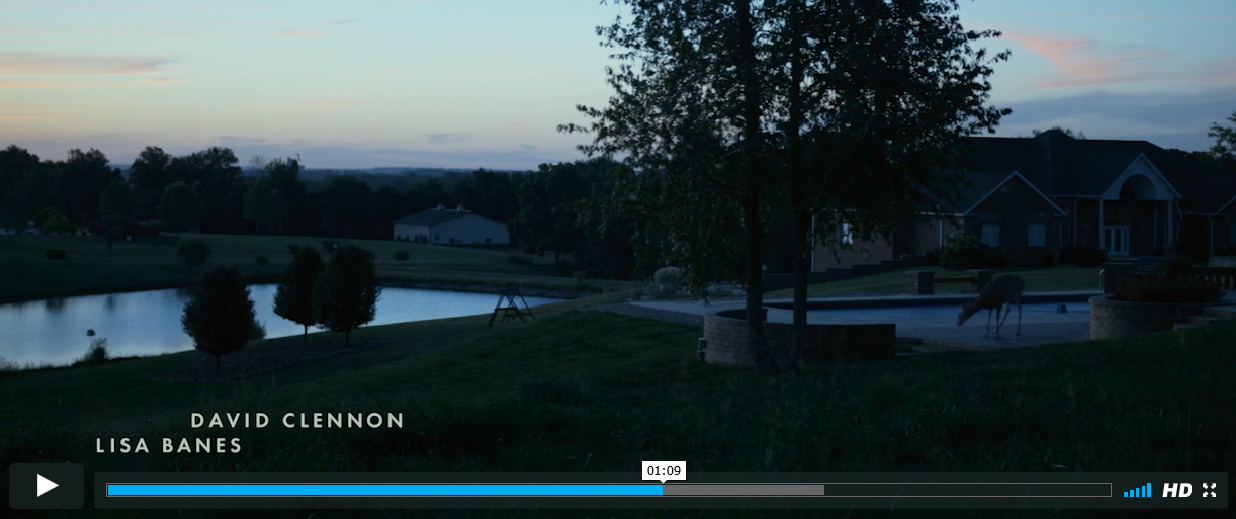
The camera then shows an establishing shot of a peaceful environment in a low key lighting which identifies to the audience that it's early in the morning and nobody is awake. The only moving object in the shot is an animal which suggests that the area is deserted and everyone is asleep as the animal is comfortably exploring the environment. The incidental, non-diegetic drone is again sound bridged into this shot which is effective as it suggests that the man speaking in the voice over has been awake for a long time as the shots have been continuous. Diegetic bird sounds are also introduced at the end of this shot which makes the scene appear more realistic to the audience and makes them feel like they are actually a part of the thriller film.
 
 
With the incidental, non-diegetic drone continuing throughout the clip, the camera shows nine different images of the environment which look like conventional thriller film settings, such as a new house, a deserted building, and a backstreet, before the camera tilts upwards to show the audience a low angle shot of an old fashioned clock in the middle of the street. The low angle shot of the clock is used to identify the significance of the clock as it confirms that it is early in the morning as it shows to be five to seven in the morning. The old fashioned look of the clock connotes a sinister atmosphere as vintage objects are conventional to thriller films. The clock could also imply to the audience that its not long before the equilibrium is broken which encourages them to keep watching.
 
 
The camera then cuts to a medium shot of the man, who was speaking in the voice over, stood expressionlessly on the end of his drive wearing casual clothes. The neutral facial expressions from the man suggests to the audience that he is tired due to his lack of sleep during the night and confused about his marriage. This links back to when the man said that he was 'trying to get an answer' from his wife's brain. This implies to the audience that the couple are having trouble with their marriage and the woman is hiding something from the man. The low-key lighting in the image suggests that the man is unaware and in the dark about hat his wife is hiding from him. The incidental, non-diegetic drone and the diegetic bird sounds are sound bridged into this shot which makes the jump cuts smoother to the audience as the sound is just continuing.
 
 
The camera then uses editing to use the match in action technique which shows the man in the same place but from an alternate angle. The man is shown in a long shot to be looking around the environment in confusion. The long shot of the man identifies his vulnerability due to the fact that he is all alone and his marriage is troubled. The man is also centre screen which implies to the audience that his character is significant to the story. This encourages the audience to pay more attention to him. The incidental, non-diegetic drone is still continuing and is conventional for thriller films as it creates a suspension and sinister atmosphere. Diegetic bird sounds are also sound bridged into this shot which implies to the audience that the man has been stood on the end of his drive from a long time as the birds have been tweeting through a number of shots. The duration of the man stood on the end of his drive is sixteen seconds and is broken down into three shots, which were matched in action. This duration of the shots allows the audience to really feel and connect with the man's emotions. This is effective as it allows the audience to understand his character a little and makes them feel like they can relate to how he's feeling. Therefore, this encourages the audience to continue watching.
 
 
The camera then shows an extreme long shot of the man walking towards house. After a second of the shot commencing, white writing appears on the screen saying 'July 5th' which implies to the audience that it's a significant piece of information for the story. The camera is at a slight low angle which makes the house appear intimidating. The house looking intimidating could also reflect his feelings to the audience and imply that he doesn't want to go back inside which suggests why he was stood outside for a long period of time. The incidental, non-diegetic drone is again sound bridged into this shot, however is slowly faded out as the screen fades to black. This is effective as it encourages the audience to keep watching to see what will happen next.
 

Crime Thriller Research: Titles

Thriller Titles

Most thriller films have the colour black for their backgrounds behind their titles with some non-diegetic music playing in the back ground to create the mood of a thriller film. Another convention about titles in thriller films is that the most important companies and actors are shown in the first credits. It’s also conventional for thriller films to have a particular event in the opening sequence before the title shots are shown which reveals what the film will be about. An example of a thriller film with a particular event which happens before the title shots are shown would be ‘Terminator 2’ (Dir, James Cameron, 1991). Another example of a thriller film with an event before the title shots
would be 'Casino Royale' (Dir. Daniel Kleinman, 2006). 


'Black Swan' (Dir. Darren Aronofski, 2011).

'Flicker' (Dir.Tony Conrad, 1996).

 'The Godfather' (Dir. Francis Ford Coppola, 1972).

'The Girl With The Dragon Tattoo' (Dir. David Fincher, 2011).

'The Sixth Sense' (Dir. M. Night Shyamalan, 1999).

'The Purge' (Dir. James DeMonaco, 2013).

It is also common for some films to start with a particular event before titles start to show which usually shows the audeince a clip of what probably the film will be about. For example, 'The Dark Knight', directed by Christopher Nolan, shows a clip of a robery by a group of criminals, and the joker is revealed as he is the main antagonist in the film.

Another convention of titles is that usually the most important film companies or actors in the film are shown first in the credits. For example, in the opening of 'Gone Girl', directed by David Fincher, the audience are shown the conglomerate film company 'Twentieth Century Fox', which produced the film and then are followed by numerous actors which star in the film, such as 'Ben Affleck' and 'Roseamund Pike'.


It's conventional for the titles in thriller films to have red writing. The colour red connotes death, passion, danger and blood which are themes which typically associate with the thriller genre. An example of red writing in the titles of a thriller film would be 'Incidious' (Dir. James Wan, 2011). The titles for 'Insidious' are very conventional of the thriller genre, with thin, gothic typography that is red, connoting death, danger and blood, all typical of the thriller genre and are similar to the whole aesthetic of the film.


Continuity Within Film

What is Continuity within Film?

Continuity in film is when actor during a film does something for example, either standing or sitting down therefore, you can edit two shots together to make it look more realistic and accurate. An example of a shot that could be used for this is a medium long shot. Continuity typically means it is a transition between one shot to another however, it makes it flow more smoothly as it does not automatically jump from one scene to another so quickly therefore, this keeps the audience more engaged. Also, it shows the shots go together more naturally.

Some types of continuity include:

·         Blooper Continuity (meaning it is physical) portrays that the audience soon notice when objects are missing or being changed within a shot. For example, if the actor is wearing different clothes or different crops.

·         Technical continuity shows unexpected changes within a shot which are also known as, jumps cuts. Furthermore, this typically reflects it is cutting out boring things within scenes such as, driving for a long time.

180* line of action Rule

The 180* line of action rule is a guideline when filming. Within a scene or conversation, the actors must have the same either left or right relationship to each other but, only at a 180* (degree) angle. However, the camera can be changed just for close ups, etc. Although, you cannot film the other side because the set will change and the actors flip sides so that the audience engage into the film more. Also, this rule allows the audience to have a greater sense of location.

Shot – Reverse Shot

This is an editing technique using during a face to face conversation, for example. It reflects the different type of shots that are explored and used such as, off shoulder shot focusing upon one person then flipping on to the other person, to get a close up therefore, it is alternate between each actor whilst they speak.

Match on action/Match cut

Match on action or cutting on action is a film or video editing technique used for continuity editing, in which one shot automatically cuts to another shot reflecting the action in between therefore, it engages the reader more. Cutting on action gives a sense of continuous time when watching the edited film. By using movements such as the actors walking, you can hide things from the audience, mainly objects and other little things that are not valid as much. So, the brain automatically adapts to following the people as there is nothing else exciting around the actors. This further engages the viewers as it may consist of different locations, characters and actors. An example of movement would be using a long shot to show the actors are walking up to a chair then, sitting down. After that, the shot will be changed to a close up of the actor as they sit down therefore, it is unnoticeable due to the fact that, all attention from the audience is payed towards the movement and not the cut, as it catches the viewers eye.